Special Places
Dunfallandy Stone
Nearest Town: Pitlochry Nearest Postcode: PH16 5NA
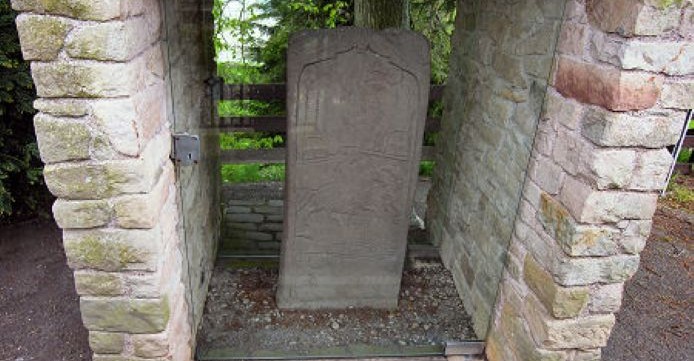
The Dunfallandy Stone is a Pictish cross slab 1.5 m high and 0.5 m wide, it was probably carved around the 8th century. A cross divided into panels of interlaced ornament and flanked by angels and beasts can be seen on the front, while on the back, framed by two serpents, are seated figures to either side of a cross, a horseman, tools and five mysterious Pictish symbols.
It is impossible to know what the symbols meant to the Picts, as they have left no written records apart from a list of their kings. Many theories have been suggested – maybe the stones marked land boundaries or the graves of important people. They may have represented tribes or noble lineages and their messages record marriage alliances.
When the Picts converted to Christianity during the late 6th/early 7th centuries, the symbols were used on shaped cross-slabs as well as on rough stones. One side was usually carved with the cross surrounded by clerics, angels and intricate patterns, while the other side was carved with a mix of Pictish symbols, huntsmen and Biblical scenes: Pictish symbols and Christian symbols together.
The use of Pictish symbols was discarded towards the end of the 9th century.
Picture copyright Lis Burke and licensed for reuse under the Creative Commons Licence.
Find this place on this path...
Creator's Website/Facebook Page
This entry was added by: Highland Perthshire Limited


